From £5k to £25k Profit: The Stoozing Blueprint for 30% Returns, 100% Risk‑Free
So this is the moment I have been patiently waiting for to scale up my Free Money Earnings via Stoozing. However, I will be doing a poor service to you all if I am not explaining my logic in full detail. If you are serious about making Free Money using someone else’s money I do really encourage you to read this post carefully and to the end. This one will be one of the most relevant posts in terms of Financial Literacy I have had the pleasure to share with you (if not the most). What I will be showing you is the process to generate a 30% return on your funds at zero percent risk. Is it possible? You bet it is. But as it is always the case, I am not expecting anyone to take my word for it. Instead, I will let the numbers speak for themselves.
Ok. So where do we start? First and foremost, I am going to assume that you are familiar with the concept of Stoozing. It is one of my main Free Money streams and it is prevalent in this Blog. In a nutshell: I borrow money from credit cards at 0% interest and park it in savings accounts. The yield over savings is my profit and the idea is to use as little as possible of our own money to generate it. If you need to deep down before proceeding to read, I have captured my Stoozing activities and methods with sufficient detail in a number of previous posts. Please feel free to revisit them for further clarification if you feel the need to do so. Here is a list for your interest.
- Stoozing or How to Make Money from Credit Cards
- How to make Free Money from Credit Cards – Stoozing 2.0
- How to make Free Money from Credit Cards – Stoozing 3.0
- How to make Free Money from Credit Cards – Stoozing 4.0
- Stoozing Fund Value
I am hoping that by the end of this reading, you will be able to understand my mindset and my insights with regard to using other people’s money (particularly credit card companies) to make money. Before I go into the nitty gritty of it, let me clarify that I am not a financial adviser and I am not telling you what to do. I am just showing you my methods, applying them and recording my results in the public domain. I have nothing to prove and nothing to hide. It is down to you to draw your own conclusions and follow suit if you feel confident to do so. If you decide that this is not for you, I hope that you can at least get some entertainment from my Journey.
A baseline Case. This is how you make £1,000 out of £10,000 borrowed money.
Right. I am going to give you a case which will be our baseline. It will constitute our template for the future since we will extrapolate results by scaling up or down as per our personal circumstances. My aim is to show you how you can make £1,000 out of £10,000 borrowed money by means of leverage combined with compounding. Here we go.
Step 1. The Enabler. A Credit Card Balance Transfer Offer at 0%.
Let’s say that we come across a credit card offer for a Balance Transfer under the following conditions:
- A Balance/Money Transfer of £10,000 (you can borrow £10,000 from them).
- We will have to pay a one-time fee of 2.90% on top of all sums transferred (that is £290 on top of the £10,000 borrowed).
- There is no interest charged on the debt for the first 24 months (if we do not pay back after 24 months, we will be charged extortionate fees of 25%-40% on the remaining debt)
- We need to pay a minimum of 1% of the outstanding balance on a monthly basis.
Step 2. Understand Liabilities over time.
This might not be entirely clear so far so let’s clarify further by running some numbers over a period of time.
Month 0:
- We apply for a £10,000 Balance Transfer.
- We are charged a one time fee of £290 as a result of borrowing the £10k.
- We owe £10,290 to the credit card company.
- We will need to pay £102.90 (1% of the debt) the next month.
What happens after the first month once the first instalment is settled?
Month 1:
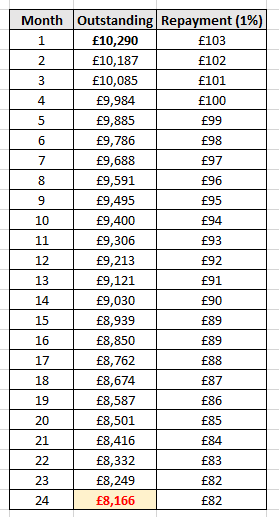
- We owe the credit card company £10,187 (10,290 – £102.90)
- The following month, we need to pay £101.87 (1% of the remaining debt).
I think we got the gist of it. Debt decreases over time as we pay 1% of the remaining balance every month. Let’s assume that we reach the end of the 0% interest period after 24 months (remember that we are not charged any interest on the debt until that moment).
………..
Month 24:
- We owe the credit card company £8,166
- As it stands, we have three options:
- Pay back £8,166
- Do nothing and keep the balance attracting a 30% APR interest over £8,166 (approx £204 on top per month every month). Not a real option here.
- Balance transfer £8,166 and start over again.
Banks and credit card companies want you in debt. Forever.
I will analyse our three options in more detail later on. For the time being, it should be abundantly clear by now why credit card companies bait you in by making it extremely easy for you to get into debt. If not, let me put it in blunt terms for you:
- To enslave you under a perpetual burden of debt;
- To make you part with your hard earned money acting as loan sharks by charging 20%-40% on whatever you owe.
- Growing their books by creating money out of nothing (yes, the money they loan you does not even exist, it is just an accounting entry and an electronic transaction). They lend the same pound you deposit in the banking system 10x to 20x times collecting interest each time.
- By fueling inflation artificially injecting credit into the system so that you need more money over time to pay for the same products and services.
And you need to understand that there is nothing wrong here. Believe it or not, it is all perfectly legal. A self feeding, self servicing endless cycle you are part of whether you like it ot not. You as any other adult should take charge and responsibility for your actions. They are just providing a service which is much needed in our society to keep consumer activity going. I am not being sarcastic here. Take your own conclusions but in my mind pure greed and evil are complete understatements which do not even make justice as to what is actually going on.
I am sorry I got carried away a little bit and started to ramble on but these are not conspiracies, just undeniable facts. Well, I am not here to play the victim. Quite the opposite, I want to show you how to take advantage of this system, fight back, turn the tables and make money out of them. Let me show you how.
Step 3. Collect Profits.
At this point, what we have so far are payments made of £2,205 over 24 months and £8,166 we still owe to the credit card company. If you had spent your £10k on a nice car or a holiday, you need to enjoy your depreciating asset and your nice memories while you can since you will need to face the fact that you need to deal with that debt sooner rather than later before it spirals out of control. But as you know, I am not here to encourage you into buying stupid items you do not actually need. Here is what we are going to do with our £10,000 instead.
We are going to deposit this money in a Cash ISA or a savings account. That’s it. Nothing fancy. Nothing genius. No investment strategies. No trading. No active involvement in managing our ‘portfolio’. Just deposit this money there and forget about it. It is not ours (it will become ours but we need some patience) and it does not even exist (just an electronic ledger in a computer).
The only condition we are going to set is that our savings will return a 5% AER on that money. And by the way, this condition can easily be met at the time of writing these lines (July 2026). Let’s work out our profits month by month:
Month 1:
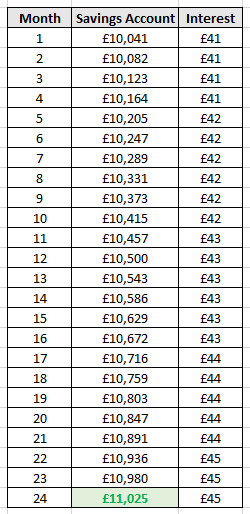
- Savings grow by £41 due to interest payments on the £10,000 deposited
- Savings account balance: £10,041
Month 2:
- Savings grow by £41 due to interest payments on the £10,041 in the savings account
- Savings account balance: £10,082
……………..
Month 24:
- Savings grow by £45 due to interest payments on £10,980 held in the account
- Savings account balance: £11,025
I trust that you are still with me because this is the clever bit where the magic happens. Let’s analyse our end product carefully.
- We now have £11,025 in the savings account. We owe £8,166. We have deployed £2,205 of our own money to service monthly payments over 24 months on an initial debt of £10,290.
- Our net profit is £11,205 – £8,166 – £2,205 = £654
- Since we only used £2,205 to generate a profit of £654, our Return on Investment (ROI) is 30% (£654/£2,205)
- We used someone else’s money to make free money risking nothing in the process.
- We did not need to front £2,205 to make this happen. We needed around £92 per month to reward ourselves with £27 Free Money per month on average.
In summary, we made use of two basic tools to make Free Money out of nothing:
- Leverage: used £2,205 of our own money to raise £10,000.
- Compounding: 5% AER on £10,000 initially deposited in savings accounts has grown to £11,025.
We may or may not have sufficient funds to service credit card payments. The point here is that the only constraint (assuming no ceiling in credit supplied by credit card companies) is the availability of funds to service credit card monthly payments. Also, please pay close attention to the fact that this money is not spent. It is just recycled into the Pot. In my particular case, I only allow myself to get in debt in such a way that my Free Money activities offset and/or surpass Stoozing outgoings. Well, if you take into consideration that I nearly have £6,000 cash and make a minimum of £125 per month from Free Money Streams, you will not need a lot of brain power here to figure out where I am heading. But I am jumping ahead of myself. Let’s finish this exercise first.
Step 4. Repeat the process and make another £1,000 but this time with a Head Start.
So you might think that that was it and that we reached the end. We did not. It was just the beginning. Let’s revisit our three final options after 24 months:
- Pay back £8,166.
- Keep the balance attracting a 30% APR interest over £8,166 (debt grows £204 per month every month).
- Balance transfer £8,166 and carry over this debt for another 24 months.
Option number 2 is just for show. It was never a real one. That leaves us with two choices:
- I can clear off £8,166 debt, pay myself back £2,205 and enjoy my £654 profit.
- I can refinance by balance transferring £8,166 leaving my own £2,205 tied up in the £11,025 kept in the savings account to grow additional profits and use more of my own money to service monthly credit card payments.
And the final answer is… none of these two. This is how it works.
We are going to balance transfer £10,000 again. Out of these £10,000, we will use £8,166 to pay off the remaining debt and the rest to pay ourselves back £1,834. However, these £1,834 will be kept in a pot and used exclusively for credit card payments. In other words, we will recycle most of our deployed money for debt repayment purposes.
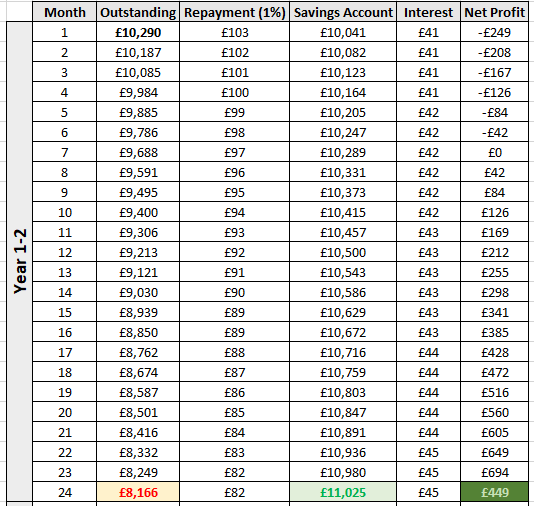
The point I am trying to get across is that we are going to repeat the whole process but from a different starting point.
We will leave £371 of our own money invested in the Pot and we will need to cover £2,205 – £1,834 = £371 with our own money in the second 24 month cycle (approx £15 per month). This method implies that £371 of our own money will remain invested every 24 months.
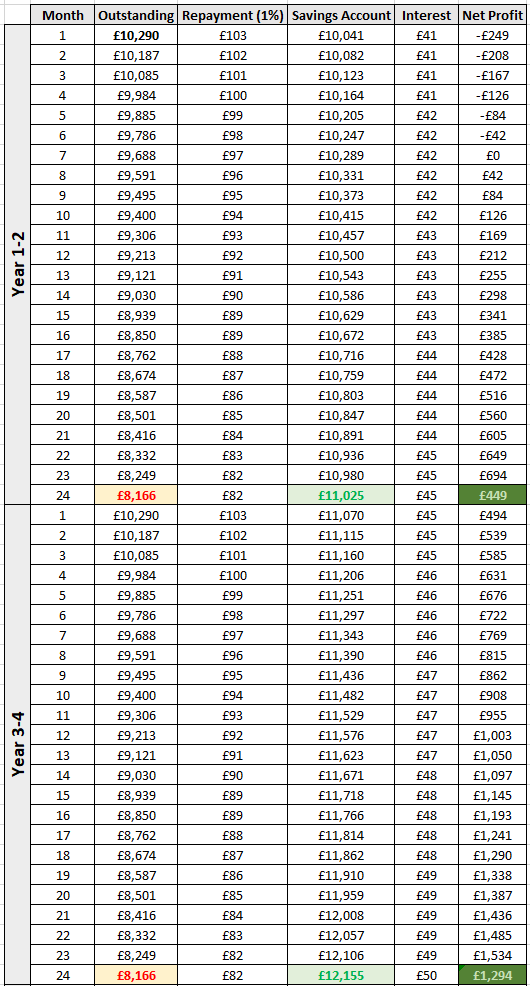
Once the second cycle of 24 months is completed, what are our profits and ROI?
- Own noney deployed: £2,205 + £371 = £2,576
- Profit: £1,584
- ROI: 62% (£1,584/£2,576)
Let’s not forget that at the end of every 24 month period we need to subtract £290 in credit card fees from our profits. OK, let’s speed up this process. What happens after 10 years or five 24 month cycles?
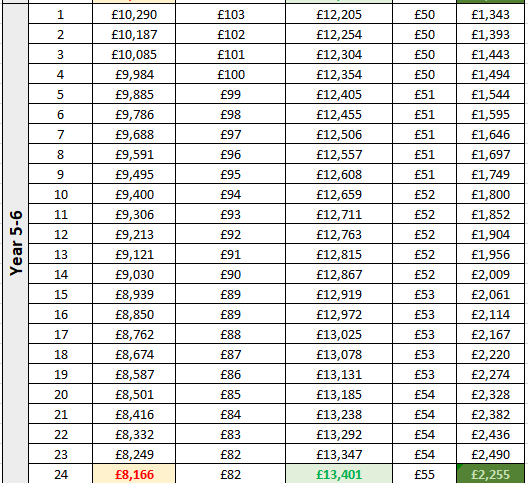
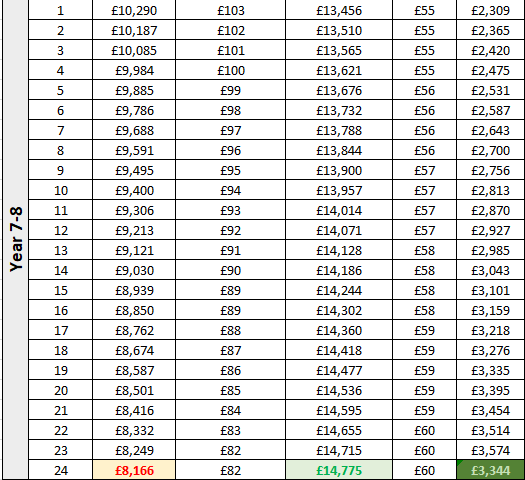
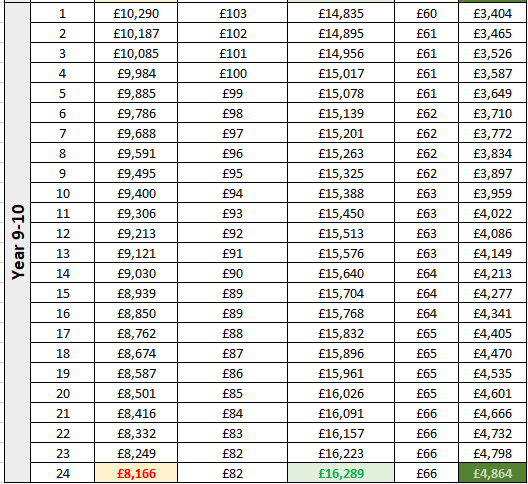
- Own money deployed: £2,205 + £371 + £371 + £371 + £371 = £3,690
- Profit: £4,864
- ROI: 132% (£4,864/£3,690)
10 years into it, we would have doubled our money and made 32% on top. Not too shabby at all for a complete risk-free investment.
The key takeaway. Scale up as much as possible. I am aiming for a £24,000 Profit Target (at least).
So, there are a huge number of scenarios in between what I have presented to you in this post and a real example given by a number of variables inside the balance transfer offer (credit limit, offer duration, fees and minimum repayment). Remember that, as a rule of thumb, the longer the offer and the lower the minimum repayment, the higher your profit and ROI. You can play with a number of different projections using different inputs in terms of credit card conditions and savings account yields. Do not forget to use our Stoozing Calculator to assess your results.
I am satisfied that the example I have shown you here is consistent with a real-life situation. Remember that I am an active stoozer keeping a record of my profits and positions in my Stoozing Fund. Please feel free to check at any time.
Now, I need you to picture this. My goal is to grow my Stoozing Fund by balance transferring £50,000 from credit cards. Once that number is achieved, I will reassess my options in terms of growing the debt or maintaining the cycle using the methods shown here. If I am successful and able to sustain this effort, I will be looking at a Stoozing Pot five times as big as the one presented:
- Stoozing Pot: £42,765
- Profits: £24,320
- Own Funds required (sourced from Free Money streams): £18,445
Can it be done? The answer is very much a resounding yes. Since I currently have £6,000 in cash, I need to come up with £1,200 per year to accomplish this feat. Since I am delivering £1,500 annually this should not be a limiting factor. I perceive that the only real constraint is the availability of credit plus suitable balance transfer offers over time given my credit history and personal financial circumstances. Same as anything else in this Blog, this is a story in the making. Sign up and join me in my Journey.